
by Marvin Duncan
THOUGHTS ON IMPUTATION
Second Corinthians 5:21
There is a subject in the Bible that most of us know about, but few of us have thought much about. This subject is called imputation. Imputation is a book-keeping term which means to charge to an account. We see this action in Paul’s letter to Philemon. Philemon was probably a rich slave owner, yet, Paul promises to pay any debt one of his runaway slaves might owe. Paul leads this way-ward slave to our Lord and he is saved. Paul then sends him back to his master, who was also a Christian, with a letter asking the owner to receive this run-away slave, not as personal property, but as a Brother in Christ. To help smooth this return, Paul writes to Philemon:
“If he hath wronged thee, or oweth thee ought, put that on mine account” (Philemon 18).
Imputed Sin Nature
There are three main areas where imputation enters into God’s plan for the ages. The first area is found in Romans 5:12 where Paul tells us that a depraved sinful nature was passed onto all ranking through Adam, the federal head of the fallen human race. Adam is the only man who became a sinner by| sinning. When Adam disobeyed God’s direct command concerning the tree of the knowledge of good and evil, he lost his creature righteousness and became a sinner. This nature of rebellion was passed on to his offspring, for we are told in Genesis 5:3, Adam begat children “in his own likeness.”
It is hard for some individuals to accept the fact that they are judged as sinners because of something Adam did, yet, this is the teaching of the Scriptures. Let us notice a few of the Scriptures that make it crystal clear that man is depraved; an enemy of God and has no relationship with God in his natural condition.
The Scriptures declare that man is “under sin” (Rom. 3:9; 7:14 & Gal. 3;22) and “in unbelief” (Rom. 11:32). We are told that man is. Incapable of pleasing God (Rom. 8:8) for he is an enemy of God (Rom. 8:7 & Col. 1:21). Man is alienated from God (Eph. 2:12) because he possesses a sinful nature (Rom. 5:12) and is “dead in trespasses and sins” (Eph. 2:1) under the sentence of death (John 3:18).
Because of his depravity, man cannot understand the things of God by his natural abilities (1 Cor. 2:14). Because of the alienation that exists between man and God because of his sin, no man seeks after God and no man can come to God on his own (Rom. 3:11-12). The answer to this dilemma is found in Romans 8:16. It is the Spirit of God who witnesses to our spirit, awakening the depraved man from his stupor and sleep. This awakening results in conviction. When the depraved man responds to the wooing of the Holy Spirit, he receives forgiveness and enters into a new relationship with his Creator.
In this matter of the unregenerated man responding to the conviction brought about by the Holy Spirit, the following things should be noted;
The natural man is incapable of hearing God’s voice (1 Cor. 2:14). He must be drawn to God because there is nothing in the natural man that would cause him to come to God on his own (cf. John 6:44). Man must respond to God’s drawing if he is to receive God’s salvation and forgiveness of his sins. In as much as man must voluntarily respond to God’s drawing, it should be clear that God’s love is not irresistible (cf. John 5:40) as some claim. Men may reject or receive God’s love. It was man-kind as a unit that Christ died for, not just for a few who were pre-selected to be saved, as some would have us believe. This point is made clear from Scriptures such as John 3:16, 18; 5:24, etc.
Man is a sinner by nature (received from Adam) and he is a sinner by practice when he begins to exercise that Adamic nature. The doctrine of imputation declares that all men are estranged from God by wicked works. Imputation further indicates that death hangs over all man-kind, but “all who believe are justified from all things which they could not be justified by the law of Moses” (Acts 13:39).
Imputed Guilt
Let us keep in mind that imputation is like someone placing their assets into our bankrupt account. This sounds almost too good to be true, but let us look into the Scriptures to see this second act of imputation in God’s plan for the ages.
It is a tragic thing to see an innocent party succumb to the debt of another. Yet, in the case of Almighty God, there was willingness to become partaker with man (short of Adam’s nature) and thus aligning Himself with man-kind He took upon Himself our sin. The imputation here is that man’s sin was imputed to Christ. The Holiness and Righteousness of Christ was charged with man’s sin (cf. John 1:29). Note some of the verses where this manner of imputation was achieved.
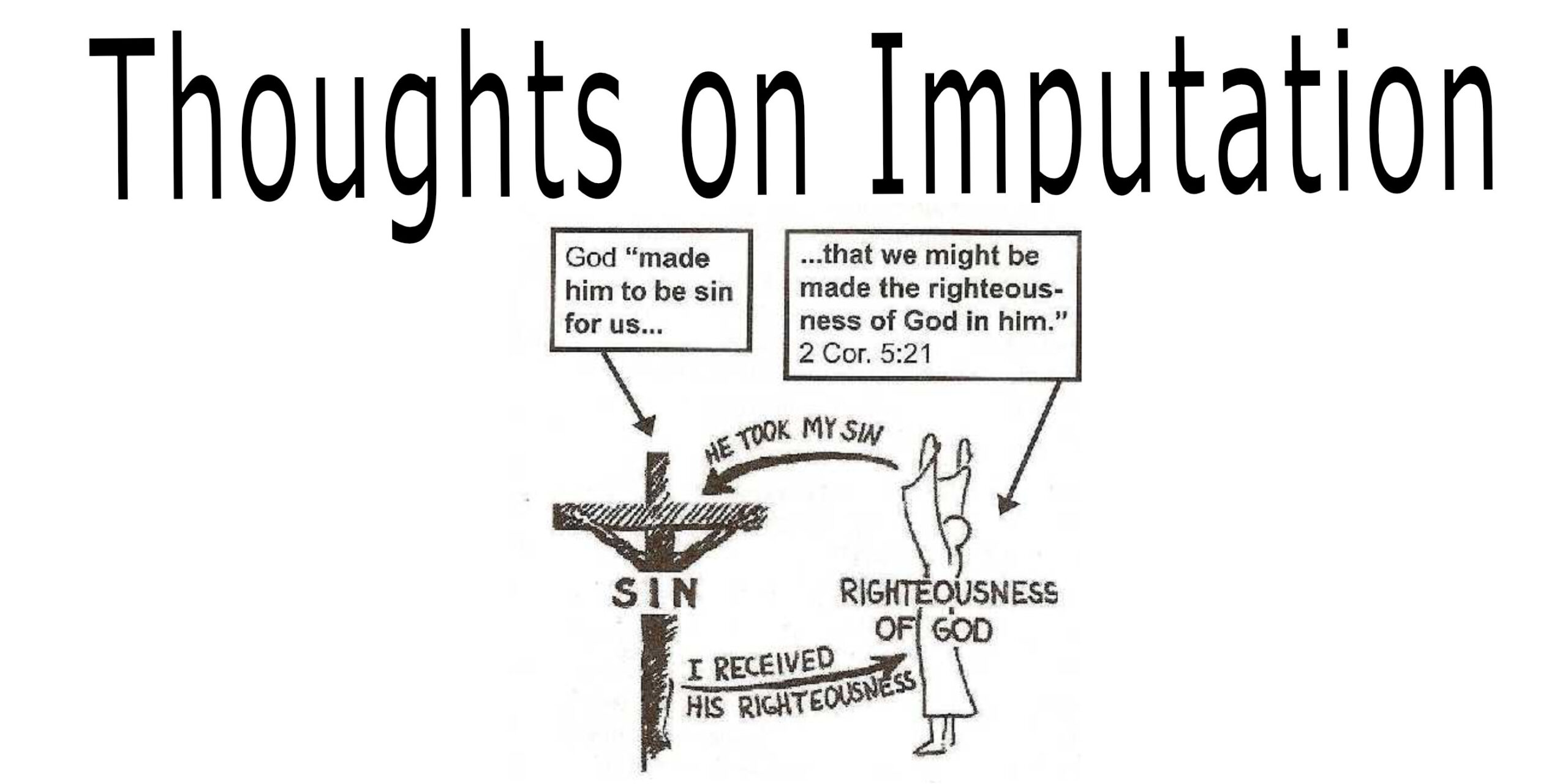
We find in Second Corinthians 5:21 that the Father made Christ to be sin for us. We are told in First Peter 3:18 that “Christ hath once suffered for sins, the just for the unjust.” The Hebrew writer tells us that in as much as the children are partakers of flesh and blood, Christ also took part of the same (Heb. 2:14). This identity was necessary for Christ to suffer in the flesh and die for our sin debt when our sin was laid upon Him (Isa. 53:6). Paul speaks of our sin being charged to Christ’s account when he tells the Romans, “when we were enemies we were reconciled to God by the death of his Son” (Rom, 5:10). This reconciliation was made possible because “God was in Christ reconciling the world unto Himself” (2 Cor. 5:19).
In a manner known only to God (1 Tim. 3:16), the Father caused Christ to “be made sin” for us. This indicates that Christ became something He was not. Here is the innocent Lamb of God becoming guilty and vile for us. It was by imputation that the death penalty belonging to us hung upon the person of Jesus Christ. He made our sin His, but in every way it was ours and we should have paid the penalty.
As we recognize what transpired in God’s ledgers when He placed our sin to the account of Christ, and Christ paid our debt in full, it should become crystal clear what this doctrine of imputation is all about. Here we see Christ; the rich Benefactor/Redeemer satisfies God’s holy and righteous demands against us because of our sins. The satisfaction of our sin debt was accomplished by imputation, that is, by God charging to Christ’s account our guilt and His paying our debt in full.
There is only one way in which our sin could become another’s. That one way is for that one to assume our sin. This Christ did by allowing our sin to be imputed to His account. By this voluntary act, Christ became the Last Adam (1 Cor. 15:45) and the Federal Head of the New Creation.
Man’s guilt and sin was taken care of by the voluntary act of Christ taking upon Himself man’s sin and dying his death payment. The guilt and sin of the world was heaped upon Christ. The Hebrews writer tells us what happened because of this. In the Book of Hebrews we read:
“But now in the end of the world hath he appeared to put away sin by the sacrifice of himself” (Heb. 9:26).
“So Christ was once offered to bear the sins of many” (Heb. 9:28).
Imputation Of Righteousness
So far we have observed two areas of imputation in the Scriptures. We have seen the charging of Adam’s original sin to humanity, and the charging of man’s sin to Christ. In both cases, the one receiving the guilt of the other had no right to that guilt. This is the result of imputation. Now we come to the third area of imputation in the. Scriptures. The Righteousness of Christ is imputed to believing sinners.
The question has often been asked, “How can God be just and still be the justifier of man?” Romans 3:26 answers this knotty question. Paul says:
“To declare I say, at this time His (Christ’s) righteousness: that He might be just and the justifier of him which believeth in Jesus” (Rom. 3:26).
Any justification must come through Jesus Christ, for the principle is
“To declare His righteousness for the remission of sins that are past” (Rom. 3:25).
The problem that needs a solution is, how can a man be justified (justification means to be declared righteous by God) when he is guilty?
How is it a man can be guilty (deserving the Lake of Fire) and yet be guiltless? The Scriptures tell us a man is guiltless because of His righteousness. But, how can a guilty sinner be righteous? The only answer has to be by imputation.
In the Book of Romans (especially chapter five) we have a great deal of Scripture devoted to the subject of imputation. We understand that Abraham “numbered and told” the stars. By this act he “believed God” which was counted to him for righteousness (Gal. 3:6). When Abraham counted the stars (Gen. 15:5) he “believed in the lord and He (the Lord) counted (imputed) it to him (Abraham) for righteousness.” Because Abraham believed the Lord and did what the Lord asked him to do, his faith was seen by God as righteousness.
Everyone who believes God and does what He asks, his faith is counted (imputed) to him for righteousness. When a man exercises his faith in doing what God asks him to do, that act of faith allows God to account righteousness in that man’s account. This is the only way any son of Adam can receive any righteousness. It has to be imputed to him by God.
We need only look at a few verses of Scripture to establish that man receives righteousness from God through the person of Jesus Christ. Romans 3:22 tells us that “the righteousness of God which is by faith of Jesus Christ unto all and upon all them that believe.” Romans 3:24 says, “being justified freely through the redemption that is in Christ Jesus.” Another verse that sets forth this truth that righteousness is by imputation is Romans 5:1 where Paul says, “therefore being justified by faith, we have peace with God through our Lord Jesus Christ.” The classic verse for Christ’s righteousness being imputed to the believer is Second Corinthians 5:21. Here Paul tells the Saints at Corinth:
“For He (the Father) hath made Him (Christ) to be sin for us, who (Christ) knew no sin, that we might be made the righteousness of God in Him.”
In order for any man to stand in the presence of our Holy God, perfect righteousness must be accounted to us and entered on our ledger sheet. God knew we did not have any righteousness of our own. But God, with His unlimited supply of righteousness, knew that He could pay the penalty for man’s guilt and sin, and it would not tax His account. This is exactly what God did for believing sinners.
Thus, God the absolute honest Bookkeeper, entered on the ledger sheet of man the sin of Adam, but in doing so found the inflicted penalty of the Holy Law was laid to His charge (Isa. 53:6). Then, God is able on the basis of paying the price of all sin, to give to those who enter by faith into a relationship with Him, Christ’s righteousness. hence, by imputation, man can stand in God’s presence, justified, reconciled and retains a perfect standing. Thus, it can be said, “ye are complete in him, which is the head of all principality and power” (Col. 2:9-10).